602.449.7980
 1747 E Morten Ave #205 Phoenix AZ 85020

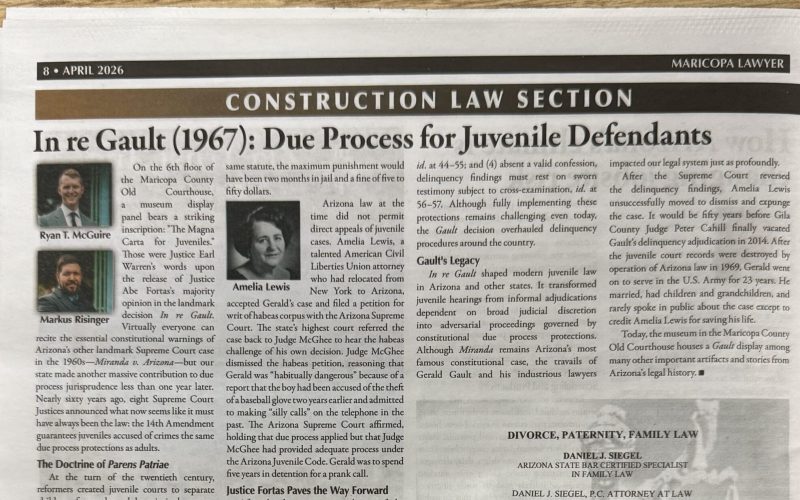
This piece was originally published in Maricopa Lawyer. [1]
By Ryan T. McGuire and Markus Risinger
On the 6th floor of the Maricopa County Old Courthouse, a museum display panel bears a striking inscription: “The Magna Carta for Juveniles.” Those were Justice Earl Warren’s words upon the release of Justice Abe Fortas’s majority opinion in the landmark decision In re Gault. Virtually everyone can recite the essential constitutional warnings of Arizona’s other landmark Supreme Court case—Miranda v. Arizona—but our state made another massive contribution to due process jurisprudence less than one year later. Nearly sixty years ago, eight Supreme Court Justices announced what now seems like it must have always been the law: the 14th Amendment guarantees juveniles accused of crimes the same due process protections as adults.
The Doctrine of Parens Patriae
At the turn of the twentieth century, reformers created juvenile courts to separate children from the adult criminal system. Previously, children were tried as adults and incarcerated in adult prisons. In theory, this new juvenile court was designed to be rehabilitative, informal, and protective, with judges acting in a quasi-parental role to guide and correct behavior with less focus on punishment. In practice, however, this informal model justified truncated procedures and fewer rights for juvenile defendants. Children rarely received legal counsel. Notice requirements were weak. Judges had practically unchecked discretion to invent procedures ad hoc.
Five Years of Confinement for a Prank Call
In June 1964, a neighbor accused Gerald Gault of uttering vulgar language during an offensive telephone call. Gerald was fifteen years old when the Gila County Sheriff took him into custody without notifying his parents. Gerald claimed his friend, Ronald Lewis, had made the call from the Gault family’s phone while Gerald was getting ready for work.
Judge Robert McGhee presided over the preliminary hearing, after which he said he would “think about” release conditions with no timeline or explanation. Gerald remained in custody for several more days before being released. Judge McGhee held a second hearing on June 15—just a few days after the arrest—and gave no notice of what Gerald should expect to occur. At the hearing, the court swore no witnesses, kept no record, and did not appoint defense counsel. Gerald’s accuser never appeared to testify. After this bizarre proceeding, the judge sentenced Gerald to confinement at the State Industrial School until his 21st birthday for making “lewd phone calls” in violation of A.R.S. § 13-377. Had Gerald been convicted as an adult under the same statute, the maximum punishment would have been two months in jail and a fine of five to fifty dollars.
Arizona law at the time did not permit direct appeals of juvenile cases. Amelia Lewis, a talented American Civil Liberties Union attorney who had relocated from New York to Arizona, accepted Gerald’s case and filed a petition for writ of habeas corpus with the Arizona Supreme Court. The state’s highest court referred the case back to Judge McGhee to hear the habeas challenge of his own decision. Judge McGhee dismissed the habeas petition, reasoning that Gerald was “habitually dangerous” because of a report that the boy had been accused of the theft of a baseball glove two years earlier and admitted to making “silly calls” on the telephone in the past. The Arizona Supreme Court affirmed, holding that due process applied but that Judge McGhee had provided adequate process under the Arizona Juvenile Code. Gerald was to spend five years in detention for a prank call.
Justice Fortas Paves the Way Forward
After the disappointing resolution of the habeas petition, Amelia Lewis called upon the aid one of her former professors, the legendary civil rights lawyer Norman Dorsen. Together, they brought the case to the U.S. Supreme Court and argued that juveniles facing confinement for delinquency ought to enjoy the same due process protections as adults. By the time arguments were heard in December 1966, Gerald had already been in confinement for two-and-a-half years.
In In re Gault, 387 U.S. 1 (1967), the Supreme Court reversed the commitment. Justice Fortas, writing for the majority, rejected the premise that benevolent aims excuse procedural deficiencies. Among many profound comments in a marathon majority opinion, Justice Fortas delivered his most enduring line: “Under our Constitution, the condition of being a boy does not justify a kangaroo court.” Id. at 28. Justice Fortas observed that Gerald’s world had become “a building with whitewashed walls, regimented routine and institutional hours.” Instead of family, friends, and classmates, “his world is peopled by guards, custodians, state employees, and ‘delinquents’ confined with him for anything from waywardness to rape and homicide.” 387 U.S. at 27.
The Court laid out four constitutional protections required when a juvenile faces possible confinement: (1) a petition alleging specific facts, with written, timely notice sufficient to prepare, id. at 33–34; (2) notice to juveniles and parents of the right to retained counsel, and appointed counsel if indigent, id. at 36–42; (3) application of the Fifth Amendment privilege against self-incrimination, making admissions inadmissible absent clear proof the juvenile understood the right to remain silent and that silence would not be penalized (i.e., juveniles are entitled to Miranda warnings), id. at 44–55; and (4) absent a valid confession, delinquency findings must rest on sworn testimony subject to cross-examination, id. at 56–57. Although implementing these protections remains challenging even today, the Gault decision overhauled delinquency procedures around the country.
Gault’s Legacy
In re Gault shaped modern Arizona juvenile law. It transformed juvenile hearings from informal adjudications dependent on broad judicial discretion into adversarial proceedings governed by Fourteenth Amendment due process protections. Although Miranda remains Arizona’s most famous constitutional case, the travails of Gerald Gault and his industrious lawyers impacted our legal system just as profoundly.
After the Supreme Court reversed the delinquency findings, Amelia Lewis unsuccessfully moved to dismiss and expunge the case. It would be fifty years before Gila County Judge Peter Cahill vacated Gault’s delinquency adjudication in 2014. After the juvenile court records were destroyed by operation of Arizona law in 1969, Gerald went on to serve in the U.S. Army for 23 years. He married, had children and grandchildren, and rarely spoke in public about the case except to credit Amelia Lewis for saving his life.
Today, the museum in the Maricopa County Old Courthouse houses a Gault display among many other important artifacts and stories from Arizona’s legal history.
[1] The original article will be linked when the electronic version is available online.
Authors:
Ryan T. McGuire is a law clerk at Woodnick Law PLLC and a second-year student at the Sandra Day O’Connor College of Law. He leverages his master’s degree in philosophy to produce thorough legal research and writing, with a focus on family law matters. Ryan brings a strong foundation in legal analysis and academic interests spanning family, juvenile, and criminal law.
Markus Risinger is an attorney at Woodnick Law and has been practicing family law since graduating from ASU’s Sandra Day O’Connor College of Law. He practices and teaches administrative law, juvenile law, family law, criminal law, and appeals.